
A dress tutorial by popular demand

 We just got back from California last night. I took a fairly small wardrobe for the trip (five changes of clothes for fifteen days).  One of the mainstays of my vacation wardrobe was this dress.


It's a variant of 


below is the schematic for the dress.


the One Hour Dress developed by the brilliant Mary Brooks Picken. The One Hour Dress is cut with wide sides that are gathered at the hips to give the wearer walking ease. I had read an article about the one hour dress years ago and tried to make the dress following the directions to pleat the sides. The final look was hugely unflattering on me but when I let the wide sides fall naturally then I ended up with a really flattering dress that looked much more complicated than it actually was. Made in a knit I can whip up one of these dresses

 not in an hour, but in something closer to twenty minutes.


My sister in law fell in love with this dress as did our friend Lisa who asked me for the pattern. I don't have a pattern per se but I have made a tutorial using paper to explain how one does the cutting. I hope that this helps.


Probably the easiest way to create this dress is to find a tank top or t-shirt that fits you well.


As for fabric - you need a length of knit fabric that folded in half will reach from your shoulder to the length that you want the dress to be. I will usually start with a 1.5 to 2 yard length of fabric. Most knits come around 55 inches wide. You want the stretch to go around your body if you want to be comfortable in the dress.

Fold the fabric in half north to south and then in half east to west.


Lay your t-shirt or tank top folded in half on the fold of the fabric.


Pay attention to the geography of the shirt, particularly where the bustline and the waistline sit.


 Now it is time to cut out your dress.Some people will chalk out the outline of the shirt. I am more likely to plunk a few tuna cans on the shirt to weigh it down so it doesn't shift, and  start by cutting the shoulderline,  and the armscye ( that's the armhole in regular English). 


Next you can continue to cut below the armscye to the waist or even lower to the hip and then cut a straight line away from the fold. and then cut a straight line down to the hem.


When you are done cutting
you will be left with something that looks like this when folded,


and like this when unfolded.

Sew the shoulder seams together and then sew the dress from below the armholeout to the side and then down to the hem. You will end up with side drapes that look complicated. Gravity turns the funny boxed sides into a complicated, sophisticated looking drape.


I see looking at this photo that I went wide at mid hip on this dress. I also didn't go very wide at the sides, I added perhaps 6-8 inches beyond my actual hip width. 


I this grey version of the dress I  cut wide at the waist.


The grey dress was made in an even lazier way.

 You can see the cutting draft below.


You can finish off these dresses any way you like.The blue dress got a twisted cowl neck. I seem to recall that I had cut the neckline funny and the twisted cowl made a mistake into --not a mistake. I turned and finished the armholes but fifteen years later I still haven't hemmed the skirt


 The grey dress was cut a bit too short so I added a slightly darker and denser grey knit facing for the hem and the dress lies better on me. 

The grey dress works best on me belted, the blue dress looks fine either way.

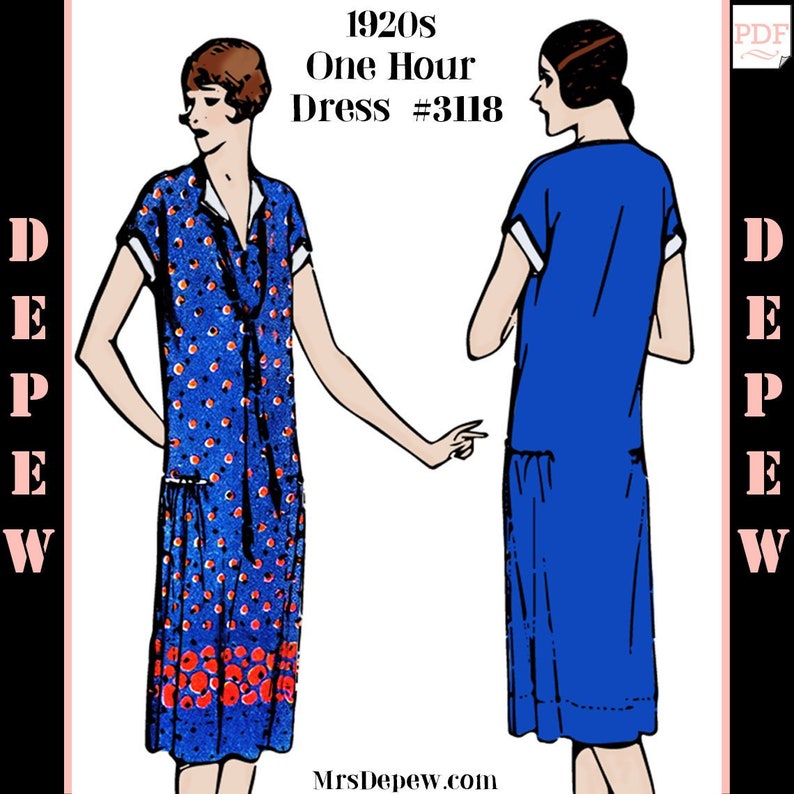
The version below is from a French fashion magazine of the 1920s. If you click on the image it will enlarge.


It's a whole lot of look for very little effort.  I have mostly made these dresses in knits but you can certainly make one or a dozen in a woven fabric, just be sure to cut the bodice part bigger to account for the fact that most wovens don't have stretch.

This dress can be made imperfectly and still look terrific. This is the dress I make when I am depressed or anxious because in twenty minutes I am less depressed or anxious because I have a new dress.

Go forth and make a dress or a dozen.

Comments

Popular posts from this blog

מְחַיֵּה הַמֵּתִים

  וְנֶאֱמָן אַתָּה לְהַחֲיוֹת מֵתִים: בָּרוּךְ אַתָּה יְהֹוָה מְחַיֵּה הַמֵּתִים   You are faithful to restore the dead to life. Blessed are You, Adonoy, Resurrector of the dead. That particular line is recited at every single prayer service every day three times a day, unless you use a Reform or Reconstructionist prayer book . In those liturgies instead of praising God for resurrecting the dead God is praised for  giving life to all.  I am enough of a modern woman, a modern thinker, to not actually believe in the actual resurrection of the dead. I don't actually expect all of the residents of the Workmen's Circle section of  Mount Hebron cemetery in Queens to get up and get back to work at their sewing machines. I don't expect the young children buried here or  the babies buried here to one day get up and frolic. Yet, every single time I get up to lead services I say those words about the reanimating of the dead with every fiber of my being. Yesterday, I e...

Connecting with the past

A few months ago I had a craving for my father’s chicken fricassee.  If my father were still alive I would have called him up and he would have talked me through the process of making it.    My father is no longer alive so I turned to my cookbooks and the recipes I found for chicken fricassee were nothing at all like the stew of chicken necks, gizzards and wings in a watery sweet and sour tomato sauce that I enjoyed as a kid.  I assumed that the dish was an invention of my father’s. I then attempted to replicate the dish from my memory of it and failed.   A couple of weeks ago I saw an article on the internet, and I can’t remember where, that talked about Jewish fricassee  and it sounded an awful lot like the dish I was hankering after. This afternoon I went to the butcher and picked up all of the chicken elements of the dish, a couple of packages each of wings, necks and gizzards. My father never cooked directly from a cook book. He used to re...

Food friday - your grandmother's food processor

My grandmother bought my mother this wooden bowl and a chopping knife, known in Yiddish as a hock-messer, soon after my parents got married. Yes, she also got them a dairy set as well. these wooden bowls and chopping knives were a big part of food prep when I was growing up. meatloaf and meat balls were mixed in this bowl. Chopped liver was made in this bowl as well. Sundays we often made chicken salad for lunch made out of chicken left over from Shabbat chopped with vegetables and mayo. That too, was made in this bowl. When I was in college my parents got their first food processor and the chopping bowls were not used as much. Several years ago, my father asked if i would like the bowls and the hock-messers. I was happy to have them. I like the sheer physicality of chopping up a big bowl of stuff into teeny pieces. While the wooden bowls have stood up well to the years of use, the hock-messers had not. The bladed which were bolted into their handles, wobbled. The blades wouldn't ...