When I first looked at this parasha in preparation for giving this d'rash this line in the Torah reading (Numbers16:15)
חֲמ֨וֹר אֶחָ֤ד מֵהֶם֙ נָשָׂ֔אתִי
I have not taken the ass of any one of them
So reminded me of the following line from the haftara (1 Samuel 12:3)
אֶת־שׁוֹר֩ ׀ מִ֨י לָקַ֜חְתִּי וַחֲמ֧וֹר מִ֣י לָקַ֗חְתִּי
Whose ox have I taken, or whose ass have I taken?
I was so familiar with this text because my older sister read this haftara in 1975. She was the first woman to read haftara on Shabbat morning at Temple Beth El in Quincy, Ma. As the first woman reading a haftara on Shabbat morning, my sister needed to be perfect. She used to ask me to listen to her practice. There are lines from this haftara that I could chant by heart even if you woke me from a deep sleep. I am grateful for the time I spent listening to my sister practice in her clear, beautiful voice because in reading Moshe's reply---I heard the words of Samuel rising and falling in my sister's voice. I am also grateful to my other sister for her incisive questions that got me to clarify my ideas for this d'rash into an argument that made sense to people not living inside of my head. Last Sunday, I met the great-grandchild of a shoe manufacturer which led me to learning about the great Shoe Strike of 1860. Most of all, I am grateful to my husband who can corral a messy pile of words and thoughts into something coherent.
Korach is such a gem of a parasha when it comes to giving a d’rash. As I look around this room, I can imagine all the thought balloons above your heads, filled with hundreds of ideas for really excellent divrei Torah.
After all, this pararsha is filled with great drama. There’s smoke, fire and death. There are miracles like sticks blooming into almond blossoms. And of course, there’s the earth suddenly swallowing up a bunch of bad guys. It’s epic -- like an Indiana Jones movie. But I am not going to talk about all that. All those action-movie elements are great, but I think they may be a distraction from what might be a more important subtext of Korah’s rebellion.
In the Midrash, and even in the Koran, there is a mythology about Korach that isn’t built on his being a rebel or an arrogant spiritual upstart. Instead, the legends about him are about his being a rich man.
 |
| Image from https://exhibitions.ed.ac.uk/record/23136 |
For instance, in ba-Midbar Rabba we are told that Korach was the comptroller of Pharaoh's palace and that when he left Egypt, he took so many treasures with him that he needed a caravan of 300 white mules to carry it.
In Ladino, Yiddish and in Hebrew, a fabulously wealthy man is described as being “As rich as Korach.” –Roich Vi Koirach In this parasha, when Korach and his people are swallowed up by the earth, it says that they, their houses ,וְאֵ֖ת כָּל־הָרֲכֽוּשׁ׃ , and all of their possessions, are swallowed up. The the word r’choosh often denotes assets or wealth, and not just household items like pots and pans. And in the next verse, in case we STILL didn’t get the point, it says “ וַיֵּ֨רְד֜וּ הֵ֣ם וְכָל־אֲשֶׁ֥ר לָהֶ֛ם “ they went down into the earth along with “all that they had.” So it isn’t enough that Korach and his pals died... their wealth got sucked into the earth as well.
As reporters and private investigators always say, when you want to begin to unravel a mystery, you need to follow the money. We need to do that here too.
So what, in fact, may really be going on here???
We usually think of the rebellion of Korach as an “up-with-the-masses” populist revolt.
Korach himself confronts Moses’ authority by insisting that all of the people are holyכִּ֤י כָל־הָֽעֵדָה֙ כֻּלָּ֣ם קְדֹשִׁ֔ים , and that God is within themוּבְתוֹכָ֖ם יְהוָ֑ה
In other words, he states that all of Am Yisrael was at Mount Sinai and saw God. That’s true, they were all there. But by the same token there were lots of people at Woodstock too. And I went to lots of Grateful Dead concerts, I saw the lights, I sang and I danced, but that didn’t make me Jerry Garcia.
Moshe could have given Korah a similar answer. He could have said, “Yes, you were all there, but I was the one who went up the mountain and saw God face to face.” But instead he says,
לֹ֠א חֲמ֨וֹר אֶחָ֤ד מֵהֶם֙ נָשָׂ֔אתִי
“I didn’t take any donkeys from the people.”
What? Korah says that all of us are holy and Moshe replies, “I didn’t take any donkeys?” How does that even answer Korah’s question?
Actually, he is answering Korah’s real question.
According to all of the traditional commentators, including Rashi, Ibn Ezra and the Ramban, this narrative takes place right after the incident of egel ha zahav the golden calf, and the b’chor in each family lost their right to serve in the mishkan. Moses has just radically rejiggered the economic structure of the community by placing the Leviim in charge of the mishkan, rather than the first born.
_(14781191601).jpg/220px-The_works_of_Josephus_(1683)_(14781191601).jpg)
Let’s assume for a moment that the first born in every family at one point worked in the mishkan -- just as the Leviim ended up doing. The first born sang in the mishkan and they also prepared the animals for sacrifice. Their reward, for this task, wasn’t just their close proximity to the divine -- they got paid.
If you look at the end of this parasha you can see a tally of what the Leviim got in this new structure: they got 1/10 of everything produced or owned by everyone else.
Now, according to the text, when there was an animal sacrifice, the officiant received the breast of the animal and the right front leg. I spent a little too much time looking up meat yields from different animals, but I found that one leg of lamb -- and this is a smallish korban -- will feed about 8-10 people I haven’t quite calculated how much meat a lamb breast yields because modern butchering /animal cut terminology has changed since biblical times. But assume it’s a lot more than a leg. Between the two you can feed a whole lot of people. I even tried to calculate the monetary value of that much kosher lamb, which if you look at today’s price at an average of $20/lb, (that doesn’t take into account purchasing your meat at Grow and Behold) m in any case,that’s a pretty large amount.
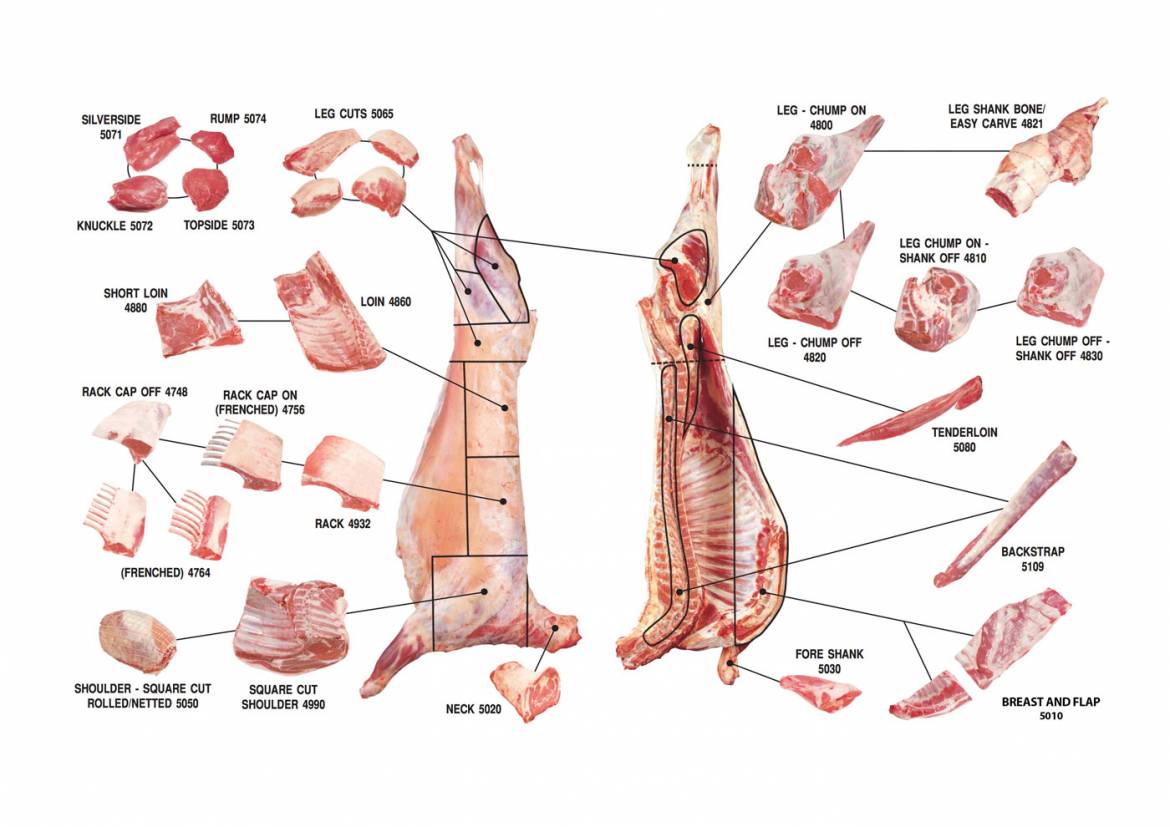
The people who serve in the mishkan also get the first (that is, the BEST) pressing of olives, the first fruits, the first of any crop, and the first born of every domestic animal. It’s a sweet gig. All of the b’chorim were getting lots of wonderful free food, too much for an individual to eat but plenty to share with your extended family.
The new system that Moses installs brings an end to that bounty shared throughout the tribes. So perhaps Korah’s complaint really isn’t simply, “We were all at Sinai.” But it may also mean, “How can we live without all those great mishkan benefits?”
We know that any change for the worse in the pocketbooks of a community will often lead to an uprising. One of the mythic moments of the founding of our country was the Boston Tea Party -- an uprising caused by the imposition of unfair taxes. Shortly after the United States was founded, in 1791, a far-reaching new tax on whisky production led to a revolt by the farmers called the Whiskey Rebellion. George Washington had to send in the army to squash it. It even had the effect of making George Washington one of the leading, and wealthiest, whisky producers in the country.
One of the rebellions I am particularly struck with occurred in 1860, as the United States was gearing up for the Civil War, and when factories were producing more goods in anticipation of the conflict.
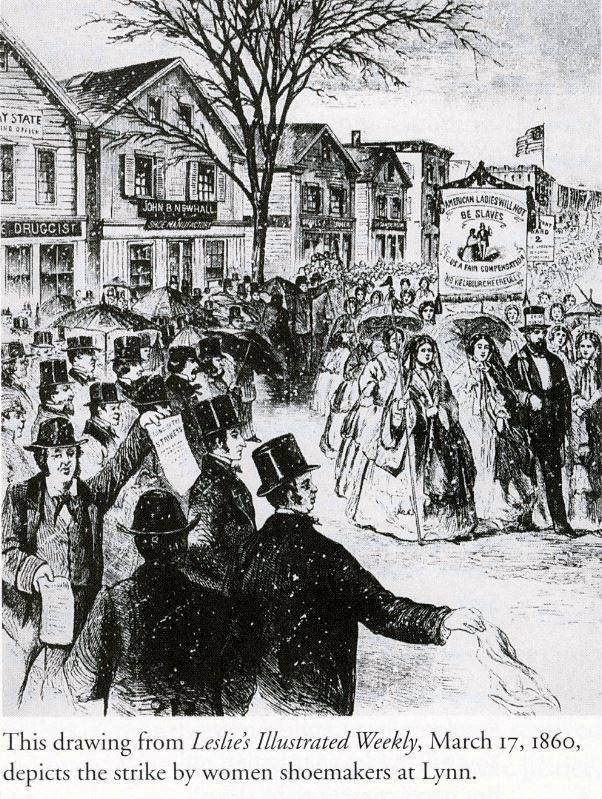
In the shoe industry, technological innovations and inventions were changing the economics, as tasks like sewing a boot top to a sole or attaching a boot heel, became faster and easier. In America, factory owners responded by lengthening work hours and lowering wages. The workers took action, and 20,000 shoe workers from upstate New York through New England, all walked out of work on Washington’s birthday. The strike shut down the entire shoe industry.
On March 8, as part of that strike, 6,000 women shoe workers marched 11 miles in a raging blizzard from Lynn, Massachusetts to Boston to protest for a raise in living wages and a reduction of the work day from 13 hours to a mere ten hours a day. They carried signs reading, "American Ladies Will Not Be Slaves: Give Us a Fair Compensation and We Will Labour Cheerfully."
 |
| http://www.masshist.org/beehiveblog/2016/06/the-lynn-shoemakers-strike-of-1860/ |
The strike actually worked. Wages were increased and working hours were shortened.
You can read Korach in the same vein. He is protesting a new economic structure. And he even offers two alternatives.
On one hand, by coming forward, he suggests that he, Korach, as a b’chor from a different branch of the Levi family, might do nicely as himself becoming the new Kohen Gadol.
Or, by bringing Datan and Avriram with him, who are from the tribe of Reuben, he may be suggesting that perhaps the role of serving in the mishkan ought to go to the b’chor of all of the tribes, rather than consolidating power just among the Leviim.
I was wondering if reading too much Marx in my youth had colored my understanding of this parasha. So, I dug around on the internet some more and found an incredible article in a fabulous journal entitled Accounting History. I hadn’t known that such a journal existed -- I didn’t know that there was even a history of accounting let alone a journal devoted to its study.
Apparently, accounting existed even before writing and even before abstract numbers. In both ancient Egypt and ancient Mesopotamia, little tokens were used to represent units of STUFF: grain, bread, gold and even human labor. Eventually, systems of accounting for most aspects of communal living were developed.
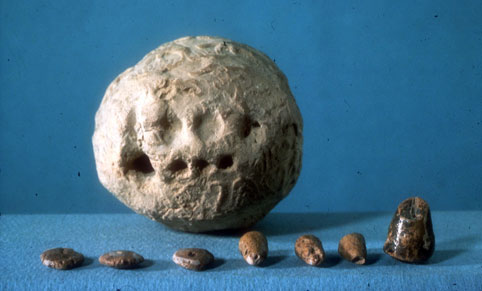
Ben Zion Barlev, a professor who teaches the history of accounting at Hebrew U, sees the descriptions of the building of the mishkan, which we read about a few parshiot back, as an itemization for every shekel spent on the project: There were 300,000 shekels collected (a half-shekel for each adult male) and this much was spent on the menorah, and that much on the hangings . . . every item is accounted for, even the hooks that held up the parochet. Barlev sees the descriptions of the furnishings of the mishkan not simply as a story, but as an accounting of every shekel spent.

Barlev continues to state that in the ancient world, there were three frameworks for accounting activity: between people doing business with one another, between the individual and the state, and between the state and the individual.
He suggests that Moshe offers a new, fourth model – of an account between a leader and his people.
 |
| https://www.pixcove.com/donkey-desert-reward-sahara-tunisia-shepherds-marshals/ |
Thus: Moshe didn’t take any donkeys.
And in rejecting Korach’s suggestions, perhaps Moshe understands that Korach, the wealthy man, is really not to be trusted. He may be too interested in gaining wealth for himself. Or for his friends. He may be a bit too self-aggrandizing to be an appropriate leader.
But Moses knows that he is implementing a system that is based on an honest and transparent accounting.
Here, let us note that the term accounting has two connotations: on one hand, it is a counting, a tally of everything you have. On the other, it denotes accountability, making sure that responsibility rests on the appropriate party.
Moses understands that a proper functioning society rests on the open, transparent and honest accounting between a leader and his people, for the way that money gets collected and spent. It is a fundamental condition for a just society.
And it has made me understand the dry and tedious business of accounting as holy work.
Shabbat Shalom
Comments
Post a Comment
I love hearing from my readers. I moderate comments to weed out bots.It may take a little while for your comment to appear.