A Darting tutorial

This is a post that will have appeal to the sewing geeks among you. If you don't care about garment construction, don't bother reading the rest of this post. 

 Yesterday one of my sewing buddies wanted to know how I figured out where to place the darts in  my daughter's birthday dress.
I had learned  a cool method from  this book
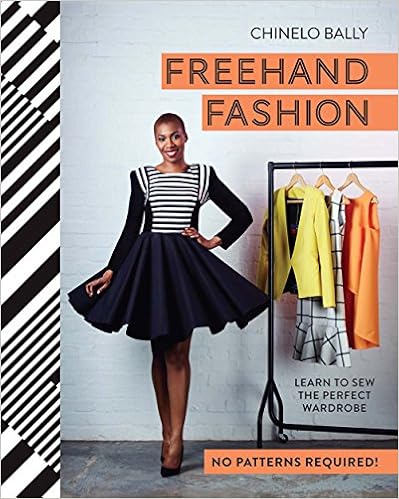
Which you can download from Amazon for not very much money, or buy on Google play for even less money.

I am using paper for this tutorial because I am not making a dress today.


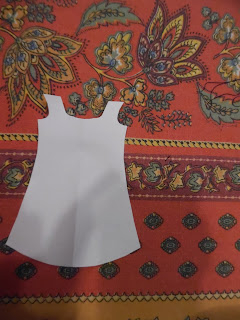
This is your basic A line dress shape. It already has a crease down the center because you have probably cut your dress out on a fold. You will need that crease later.


Fold the dress where you want the starting point of your waist dart. Press that fold well. 

Do the same for the ending point of that dart.

Then fold the dress on that center line. Waist darts are often put in line with the top shoulder point. In this paper sample the darts are placed a bit closer to the center of the dress. Fold the dress where you want to place the dart. Press hard so the press line shows up on all layers of the fabric


Use the lines you pressed into the dress to form the waist darts.
I was also asked about how I do neckline darts.  Often when I cut a sheath dress like this out of a woven fabric, the fabric at the upper chest tends to sit away from my body. Neckline darts are an easy fix.

This is how I add the darts.
I cut a nip into the fabric with the dress folded along the center line.

Sew the dart shut starting about a presser-foot away from  the fold and then angling your stitching line down to nothing.

Depending on your build you might need more than one set of neckline darts.  You can get clever with the placement of the dart if you are working with a striped fabric. You can also play with where in the neckline your dart goes.

That's it a no fuss way to get some nice shaping in a dress.

Comments

Popular posts from this blog

מְחַיֵּה הַמֵּתִים

  וְנֶאֱמָן אַתָּה לְהַחֲיוֹת מֵתִים: בָּרוּךְ אַתָּה יְהֹוָה מְחַיֵּה הַמֵּתִים   You are faithful to restore the dead to life. Blessed are You, Adonoy, Resurrector of the dead. That particular line is recited at every single prayer service every day three times a day, unless you use a Reform or Reconstructionist prayer book . In those liturgies instead of praising God for resurrecting the dead God is praised for  giving life to all.  I am enough of a modern woman, a modern thinker, to not actually believe in the actual resurrection of the dead. I don't actually expect all of the residents of the Workmen's Circle section of  Mount Hebron cemetery in Queens to get up and get back to work at their sewing machines. I don't expect the young children buried here or  the babies buried here to one day get up and frolic. Yet, every single time I get up to lead services I say those words about the reanimating of the dead with every fiber of my being. Yesterday, I e...

Connecting with the past

A few months ago I had a craving for my father’s chicken fricassee.  If my father were still alive I would have called him up and he would have talked me through the process of making it.    My father is no longer alive so I turned to my cookbooks and the recipes I found for chicken fricassee were nothing at all like the stew of chicken necks, gizzards and wings in a watery sweet and sour tomato sauce that I enjoyed as a kid.  I assumed that the dish was an invention of my father’s. I then attempted to replicate the dish from my memory of it and failed.   A couple of weeks ago I saw an article on the internet, and I can’t remember where, that talked about Jewish fricassee  and it sounded an awful lot like the dish I was hankering after. This afternoon I went to the butcher and picked up all of the chicken elements of the dish, a couple of packages each of wings, necks and gizzards. My father never cooked directly from a cook book. He used to re...

Food friday - your grandmother's food processor

My grandmother bought my mother this wooden bowl and a chopping knife, known in Yiddish as a hock-messer, soon after my parents got married. Yes, she also got them a dairy set as well. these wooden bowls and chopping knives were a big part of food prep when I was growing up. meatloaf and meat balls were mixed in this bowl. Chopped liver was made in this bowl as well. Sundays we often made chicken salad for lunch made out of chicken left over from Shabbat chopped with vegetables and mayo. That too, was made in this bowl. When I was in college my parents got their first food processor and the chopping bowls were not used as much. Several years ago, my father asked if i would like the bowls and the hock-messers. I was happy to have them. I like the sheer physicality of chopping up a big bowl of stuff into teeny pieces. While the wooden bowls have stood up well to the years of use, the hock-messers had not. The bladed which were bolted into their handles, wobbled. The blades wouldn't ...