The work part of my day was being interviewed about the possibility of a teaching gig. Things are looking good and it should be a nice addition to my summer.
I had planned to visit the Musuem of Art and Design with my youngest after the interview. He met me at the museum. I was dying to see the Judith Leiber exhibit. The last big exhibit of her work was at FIT just over 20 years ago years ago. When THAT exhibit was up I took my older son who was then really little to fill up the time between the end of his day at day care at the time we had to pick my daughter up at her school bus. My son was so enchanted by the exhibit that he asked to go back several times, and we did.
The current exhibit was fine but had none of the magic that the brilliant Valerie Steele adds to every exhibit at FIT. We saw cool pocketbooks, but no magic.
We stopped by this exhibit. I might not be clever enough to understand the premise of the exhibit. It seems to be made up of random clothing-ish related pieces. I did LOVE this installation sleeves.

 This would have been cool enough on it's own but an accompanying film explains how designer Lucy Jones is making clothing specifically to meet the needs of people who have physical challenges. These sleeves have been designed for women who can't straighten their arms.
 Some were familiar to me from craft books and articles I remembered reading in the 1970's.


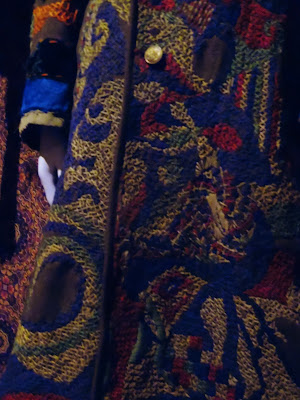
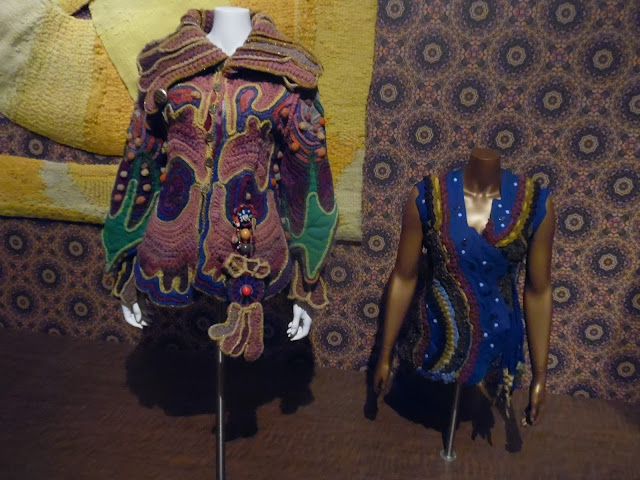


 Clearly, people had time to embellish.


 My older sister used to embroider ready made men's chambray shirts for herself. . This is the sort of woerk she might have done in the early 1970's.


 This would have been cool enough on it's own but an accompanying film explains how designer Lucy Jones is making clothing specifically to meet the needs of people who have physical challenges. These sleeves have been designed for women who can't straighten their arms.
I expected to hate the exhibit on Counter Culture Clothing. Instead, I was completely delighted by it.
Some of the garments were clearly made as stage-wear.


I was entirely smitten by the dense large scale cross stitching on this old army coat. The mix of the subtle colors and the rough stitching was so sophisticated and unexpected.


Some garments suffered from a bit too much of too much.

I was struck by how labor intensive so many of the garments were.
This skirt and top were made out of bed sheets completely covered with spectacular embroidery.


At first glance, I thought that this vest was simply faded denim.But it has been embroidered to mimic faded denim.


I remember some of these garments because I wore similar ones. Oh! the great lure of prairie dresses for those of us who attended bar and bat mitzvah parties in the early 1970's.

Versions of this denim skirt made out of jeans have appeared in every DIY fashion book since 1969. This is a particularly nice one that has been made with real skill. My cool friends were wearing short versions of this skirt in 1974.

One of my older sisters sewed and I believe that she owned the Vogue version of this pattern.


Even my mother in law owned a dashiki shirt.
There were garments that were deeply familiar to me.


We all embroidered our jeans and our denim skirts.

Some of my parents' cooler friends might have worn something like this. I don't quite understand the mania then for body armor like jewelry. It does look cool but it must have weighted a ton, I also assume that your friends couldn't hug you if you wore that assemblage.

My son dubbed this "sexy grandma clothes".

Comments
Post a Comment
I love hearing from my readers. I moderate comments to weed out bots.It may take a little while for your comment to appear.