I have a vivid memory from the fall of third grade. It was soon after Sukkot. My friend Miriam and I were standing by our cubbies and one of our teachers brought Miriam an etrog. Miriam told me that her mother was making etrog jam. Various members of our school community gave Miriam etrogim to bring home. When the jam was ready, Miriam's mother would distribute jars of the jam to everyone who gave an etrog in to help the process.
I was entirely charmed. First of all I had never known that anyone could actually make jam at home. I loved the idea of taking something so essential for the holiday and transforming it into something wonderful rather than tossing it after the holiday.
Miriam's mother Rachelle was an old buddy of my mother's from her Brooklyn days. Rochelle was renown for her excellent skills in the kitchen. My mother had grown up in a house with a terrible cook and had carefully learned how to cook. Rachelle had grown up in a home where good cooking mattered at least as much as being smart and intellectually curious did.
After that fall morning in 3rd grade, I spent a massive amount of time reading and re-reading my mother's collection of cookbooks. I especially focused on reading the chapters on making sweets,jams, jellies and desserts.
In 1978, Rachelle self published a collection of her recipes. That cookbook was one that my mother turned to again and again. After my mother died, I took Rachelle's cookbook.
Hoshanah Rabba I went to morning services and was able to take home three extra etrogim in addition to the giant one that my husband bought for us this year. I would have made the jam last week but I was not feeling up to it.
Today was jam making day. I know from my years reading jam recipes that if you make a citrus peel jam you need to boil the rinds in several changes of water to rid the fruit of excessive bitterness.
I looked at Rachelle's recipe.


 I ladled the jam into a clean jar.

Tonight, I checked the jam, and it looks like actual jam. I am grateful both for Rachelle's inspiration and for the phantom cooking advice that worked so well.
I was entirely charmed. First of all I had never known that anyone could actually make jam at home. I loved the idea of taking something so essential for the holiday and transforming it into something wonderful rather than tossing it after the holiday.
Miriam's mother Rachelle was an old buddy of my mother's from her Brooklyn days. Rochelle was renown for her excellent skills in the kitchen. My mother had grown up in a house with a terrible cook and had carefully learned how to cook. Rachelle had grown up in a home where good cooking mattered at least as much as being smart and intellectually curious did.
After that fall morning in 3rd grade, I spent a massive amount of time reading and re-reading my mother's collection of cookbooks. I especially focused on reading the chapters on making sweets,jams, jellies and desserts.
In 1978, Rachelle self published a collection of her recipes. That cookbook was one that my mother turned to again and again. After my mother died, I took Rachelle's cookbook.
Hoshanah Rabba I went to morning services and was able to take home three extra etrogim in addition to the giant one that my husband bought for us this year. I would have made the jam last week but I was not feeling up to it.
Today was jam making day. I know from my years reading jam recipes that if you make a citrus peel jam you need to boil the rinds in several changes of water to rid the fruit of excessive bitterness.
I looked at Rachelle's recipe.
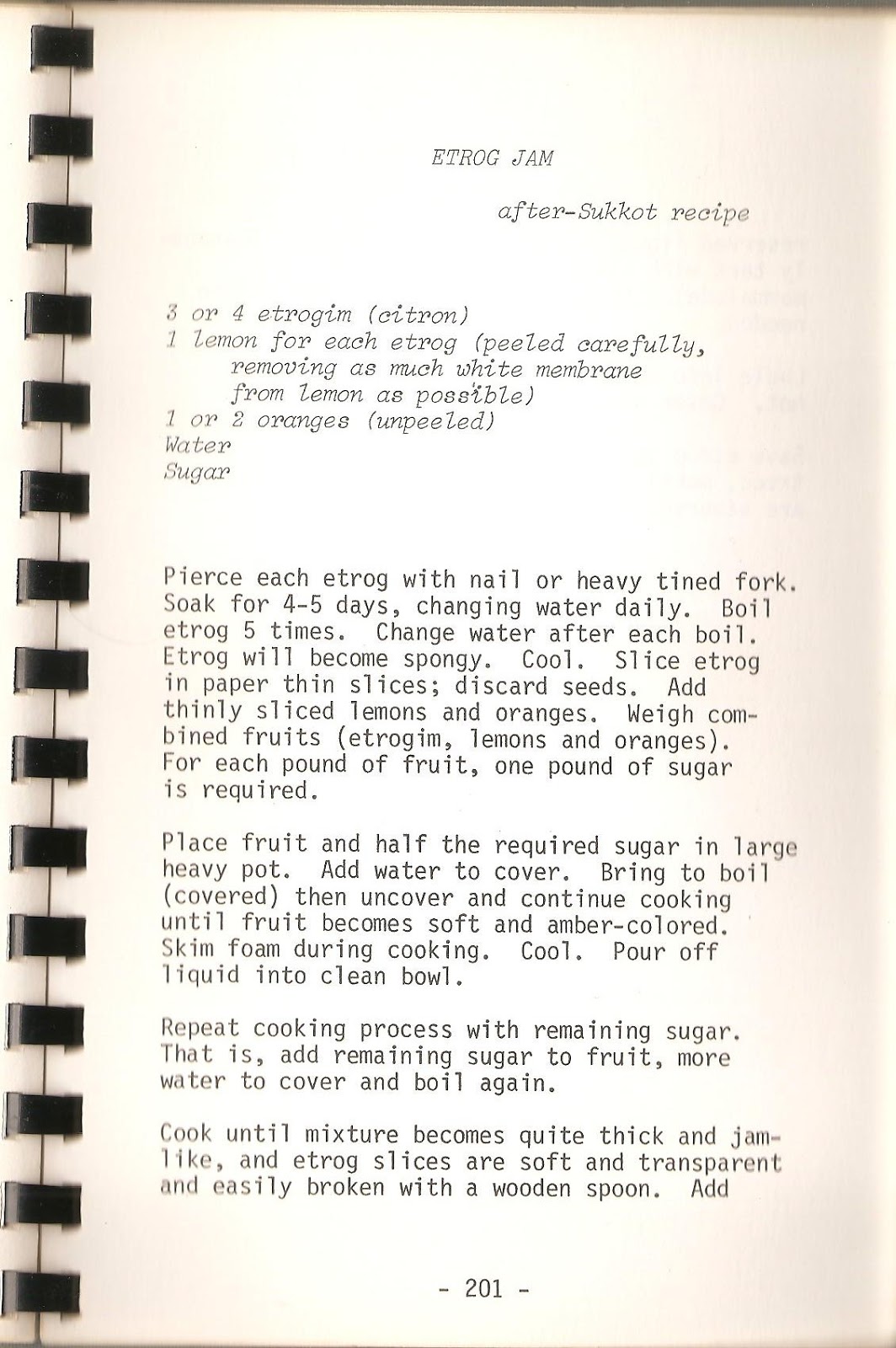

I didn't want to wait five days to begin making the jam. I decided that the old fashioned method of slicing up the etrogim, boiling them up in water, dumping the water and starting again would probably work just as well. I changed the water three times. I have seen some recipes that call for five changes of water, but one of the simmers was a long one, so I figured it was good enough.
No, I didn't weigh the fruit and then measure in an appropriate amount of sugar. I just guessed an amount and then simmered sugar, some water and chopped up etrog for a long time. Part of me felt like I might end up with a failure. Never the less, I was willing to accept something closer to a compote than to a jam and count that as a success.
As I stirred the mixture with a wooden spoon as if from a dream bits of etrog jam making advice floated into my head. As the fruit cooked and broke down the seeds floated to the top of the pan. "As you stir skim the seeds from the surface with a wooden spoon and discard." I don't know where that bit of advice came from. But I followed it and my trash can is filled with what looks like nearly 100 etrog seeds.

I wondered how much cooking is enough. And then " Cook until the fruit is translucent." appeared in my head. I followed the phantom advice.


Tonight, I checked the jam, and it looks like actual jam. I am grateful both for Rachelle's inspiration and for the phantom cooking advice that worked so well.
Comments
Post a Comment
I love hearing from my readers. I moderate comments to weed out bots.It may take a little while for your comment to appear.