Last week was a really hard week. Each day came with terrible news. I’m fine and my kids are fine. But a relative was diagnosed with a terrible illness. A friend’s child woke up dead and a sweet young man committed suicide. It’s all a bit much to assimilate in just a few days. It does make it hard to work.
My kids have begun subscribing to Netflix. We have been enjoying an orgy of reality TV. My son now claims to be addicted to Intervention . Watching Hoarders has convinced me that we don’t need to keep quite as much stuff as we currently keep around. My husband gets very attached to objects. He also feels strongly that just a few holes or wear spots doesn’t mean that something isn’t perfectly good.
I was given a block printed table cloth several years ago. It had belonged to my friend’s mother. it’s hand printed cotton from India and was purchased from Bonwit- Teller in the mid 1960’s. I assume that when it was new it had a coarse feel. It's been washed so often that it is now as soft as gauze. The cloth has several wear holes and many stains. I cut the cloth into blocks along the large squares of the design. I discarded the damaged squares. I stacked two squares together with the right sides facing out. I serged the squares together. Then I folded the edges twice to the inside and stitched a decorative stitch in the ditch. I used an orange rayon thread, because it needed to get used up.
Now, I have three new napkins. You could say that this was a complete waste of time and effort. I don't see it quite that way. The cloth that was not so nice to use because of the holes and stains is no longer in circulation. The three napkins take up a whole lot less room than the one damaged cloth. I love the cloth and how it is just a slice of textile history. One of the hardest things for me to do are the refined bits of sewing. Practicing beautiful mitered corners means that when I need to do a lovely mitered corner on a tallit or a challah cover, I will be able to di it with ease and finesse.
I also find that these sorts of nearly mindless projects tend to prime the creative pump. I’m always grateful that I have spent time on these dumb on the face of it projects.

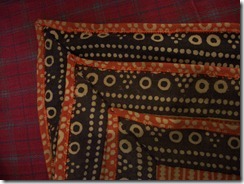
Here you can see the napkin lining. The napkins are so soft they would disintegrate without the lining. I realized that the folded hems will add to the longevity of the napkins.
All of my old sewing books talk about thrifty measures to remake worn our household goods so they will be useful. I see this table cloth to napkin transformation as part of that tradition of thrifty home making. We often struggle with objects that are worn, we have fondness for but can’t really use because they are damaged. I find that those damaged but beloved objects often take up an awful lot of space in my home and in my life. I’m glad that I came up with a solution that keeps the table cloth in my life but in an un-burdensome way.
So perhaps we aren’t hoarders after all.
My kids have begun subscribing to Netflix. We have been enjoying an orgy of reality TV. My son now claims to be addicted to Intervention . Watching Hoarders has convinced me that we don’t need to keep quite as much stuff as we currently keep around. My husband gets very attached to objects. He also feels strongly that just a few holes or wear spots doesn’t mean that something isn’t perfectly good.
I was given a block printed table cloth several years ago. It had belonged to my friend’s mother. it’s hand printed cotton from India and was purchased from Bonwit- Teller in the mid 1960’s. I assume that when it was new it had a coarse feel. It's been washed so often that it is now as soft as gauze. The cloth has several wear holes and many stains. I cut the cloth into blocks along the large squares of the design. I discarded the damaged squares. I stacked two squares together with the right sides facing out. I serged the squares together. Then I folded the edges twice to the inside and stitched a decorative stitch in the ditch. I used an orange rayon thread, because it needed to get used up.
Now, I have three new napkins. You could say that this was a complete waste of time and effort. I don't see it quite that way. The cloth that was not so nice to use because of the holes and stains is no longer in circulation. The three napkins take up a whole lot less room than the one damaged cloth. I love the cloth and how it is just a slice of textile history. One of the hardest things for me to do are the refined bits of sewing. Practicing beautiful mitered corners means that when I need to do a lovely mitered corner on a tallit or a challah cover, I will be able to di it with ease and finesse.

I also find that these sorts of nearly mindless projects tend to prime the creative pump. I’m always grateful that I have spent time on these dumb on the face of it projects.

Here you can see the napkin lining. The napkins are so soft they would disintegrate without the lining. I realized that the folded hems will add to the longevity of the napkins.
All of my old sewing books talk about thrifty measures to remake worn our household goods so they will be useful. I see this table cloth to napkin transformation as part of that tradition of thrifty home making. We often struggle with objects that are worn, we have fondness for but can’t really use because they are damaged. I find that those damaged but beloved objects often take up an awful lot of space in my home and in my life. I’m glad that I came up with a solution that keeps the table cloth in my life but in an un-burdensome way.
So perhaps we aren’t hoarders after all.
Comments
Post a Comment
I love hearing from my readers. I moderate comments to weed out bots.It may take a little while for your comment to appear.